Blog

  • (We now sow) Spectre Shells | Rachel Honnery

    Selected for the Northern Beaches Environmental Art & Design Prize, Manly Art Gallery and Museum, (We now sow) spectre shells reshapes recycled plastics into abstract sea shell forms to highlight issues of marine plastics in our oceans. It visualises hybrid marine creatures as a lament to environments polluted by plastic and as a predictor of dystopian malignant sea environments. 

    2021, repurposed plastic bags and acrylic, 140cm (w) 130cm (h)

  • Tangled | Rachel Honnery

    Tangled alludes to oating islands, cloud patches or falling nests centred in the canvas, framed by white space, masking the reality of human waste in ambiguity. These isolated islands compel us to question their identity. Occasionally we perceive glimmers of representativeness, rope or sticks emerging out of an ensnared mess, hints of sh netting and vibrant plas- tic colour.


    Tangled 01, Oil on paper, 130x100cm, 2016


    Tangled 02, Oil on paper, 130x100cm, 2016


    Tangled 03, Oil on paper, 130x100cm, 2016


    Tangled 04, Oil on paper, 130x100cm, 2016


    Tangled 05, Oil on paper, 130x100cm, 2016

  • MFA Post Graduate Exhibition | Rachel Honnery

    absolute kippleization;
    The Plastosystem

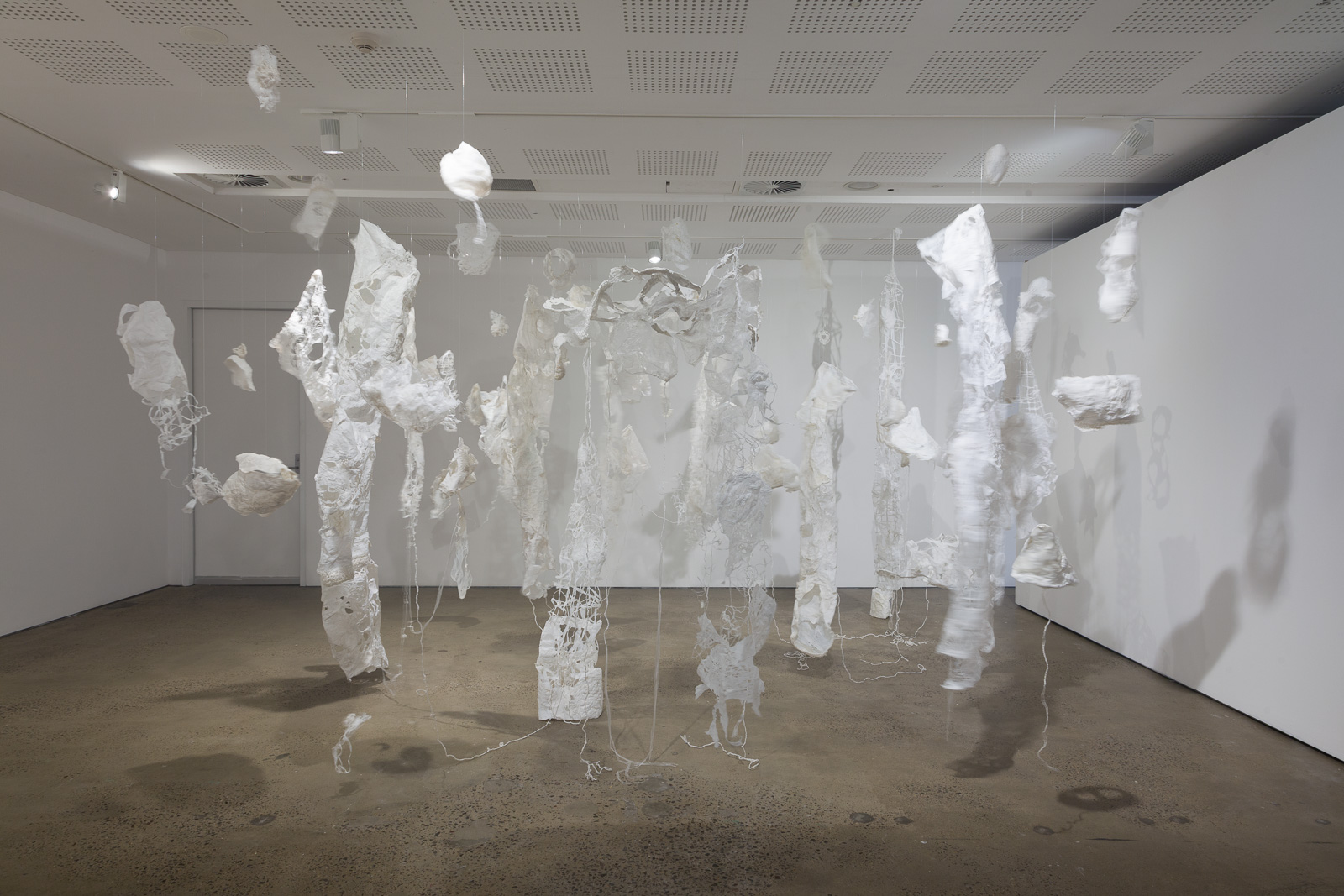
    Combining scientific investigation, method and data, with visual analysis and interpretation, Rachel Honnery’s work reminds us of the vast and overwhelming challenges that we confront in the age of the Anthropocene. This research has culminated in two inter-connected projects: absolute kippleization, andThe Plastosystem.

    Deriving its name from P.K. Dick’s post-apocalyptic novel ‘Do Androids Dream of Electric Sheep?’, absolute kippleizationinvestigates the useless objects that to consume everyday life. For this project, Honnery collected, documented, cleaned and categorised hard plastic that had accumulated at Congwong Beach at La Perouse over a 12-month period. The result is a confronting testimony to the disposable attitude that characterises our consumer-driven modern society.

    This project expanded into The Plastosystem, represented  here as an underwater graveyard to the past and predictor of a future malignant environment. This installation visualises hybrid marine creatures that have been forced to evolve in order to survive in an environment polluted by plastic. Through the fusion of science and art, Honnery considers a future dystopian marine environment that may not be so far away.

    • Courtesy of UNSW Galleries

    The Plastosystem UNSW Galleries installation, re-purposed plastic bags, 2017.

    Photo courtesy of Docqment Photography.

  • Bird Plate Designs 2005 | Rachel Honnery

    Posted on March 21, 2012 by rachel
    This entry was posted in Art by rachel. Bookmark the permalink.

  • Impermanence of Things 2010 | Rachel Honnery

    I am fascinated with the Japanese concept of “mono no aware”: the impermanence of things. This is epitomised in cherry blossoms that emerge and then drift away, a moment experienced and gone. Australia is not a cherry blossom country, but a wild and ravaged land of extremes, yet its flora is equally transitory.

    “The Impermanence of Things” captures the impermanence of blossom-shaped forms adrift on a breeze. The ephemeral nature of moving blossoms, an abstracted and blurry moment.


  • Ramparts around the valley’s edge | Rachel Honnery

    This body of work explores the unique landscapes of the Blue Mountains, the Wollemi and the western plains beyond. Growing up in this unique part of NSW, I have fond memories of hiking through National Parks, clambering over rocks and swimming in local waterholes. My current landscape paintings reflect these experiences and contrast the lingering light of early autumn evenings with the intensity of hot summers and drought.


  • Parched Earth 2003 | Rachel Honnery

    Posted on March 21, 2012 by rachel

    This entry was posted in Art by rachel. Bookmark the permalink.

  • Experiments with mapping glacial melt | Rachel Honnery

    Posted on September 9, 2018 by rachel

    These images use light and re-purposed plastics to map glacial melt in the Arctic.

    This entry was posted in Art by rachel. Bookmark the permalink.

  • Blanket for detritus | Rachel Honnery

    Pearl Beach Arboretum, 2023

    Blanket for detritus is a distorted crocheted blanket resting on the detritus of the arboretum’s floor. The blanket has vine like tendrils that wrap around the trees in which it lies between. By highlighting the floor of the bush; dried decomposing leaves, invertebrates, fungi, algae, bacteria, and the biochemistry that maintains soil nutrients; this artworks emphasises the importance of this ecosystem in supporting the overall health of the larger flora and fauna in which it is found.

  • Residue of a Polar Past | Rachel Honnery

    Residue of a polar was an exhibition at Airspace Projects, Sydney. It investigated the impact of climate change on Svalbard in the Arctic Circle. This work is a lament for ice, a farewell documenting the transformation of the Arctic Circle from white to blue.

    Residue of a polar north asks, “what will the Arctic look like in the future?” and imagines new possibilities as a way to counter environmental shock. The work encourages usto think outside ourpresent human experiencesby exploring a possible future. A place where the polar region has been transformed from white (ice) to blue (ocean). A place where icebergs no longer float, crackle and glisten.

    Photographs by Docqment Photography

    Installation view of Residue of a Polar Past exhibition, 2019
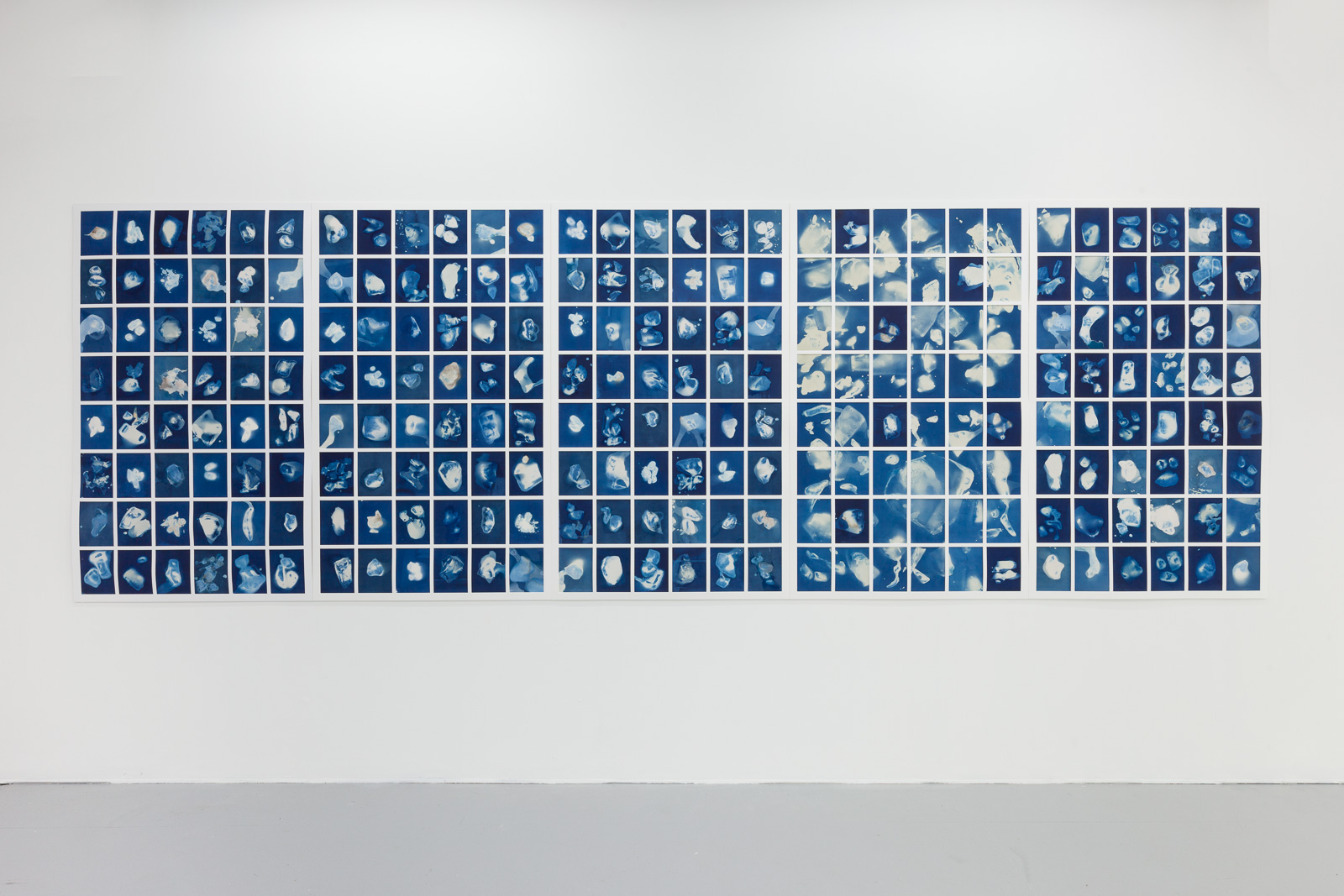
    Residue of a Polar Past, 2019, cyanotypes on watercolour paper

    Installation view of Residue of a Polar Past exhibition, 2019

    Graveyard, 2019, crocheted cotton, crystals

    Installation view of Residue of a Polar Past exhibition, 2019

    Graveyard (detail), 2019, crocheted cotton, crystals

    Graveyard (detail), 2019, crocheted cotton, crystals

    Installation view of Residue of a Polar Past exhibition, 2019

    Residue of a Polar Past, 2019, cyanotypes on watercolour paper